
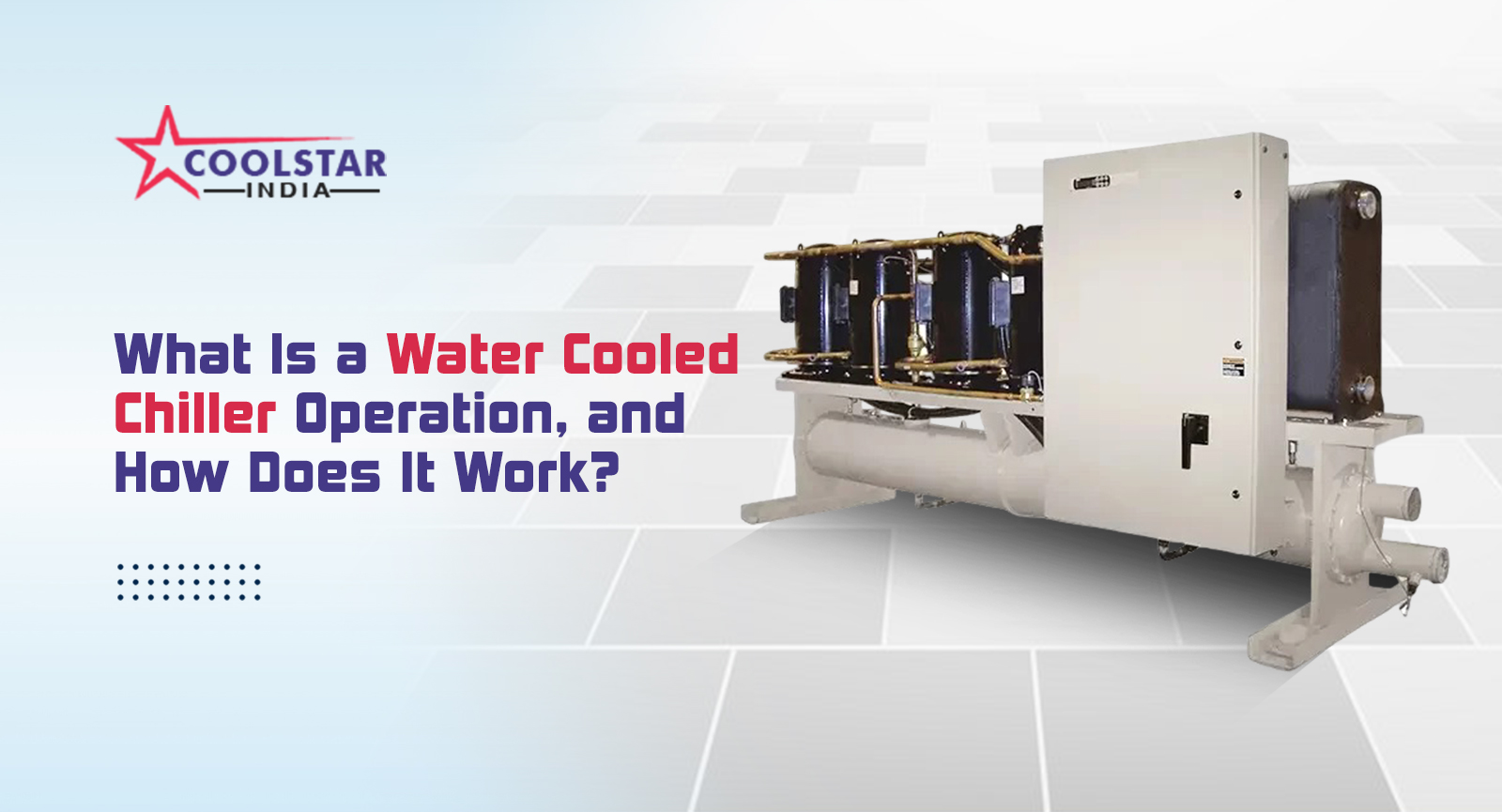
Cooling systems are used in the commercial and industrial sectors to maintain temperature. Water cooled chiller are one of the systems used for this purpose. Their operation is based on removing heat from a process or area and transferring it into cooling water, which is then circulated for use. The chiller provides a constant cooling effect. It used water as a medium to absorb and carry away unwanted heat.
A Water Cooled Chiller is a type of chiller that takes heat from water to cool it for usage in projects, industries, or homes before reintroducing the water into the operating cycle. In reality, chillers transport heat from one location that requires temperature control to another. As a result, the chiller is not a technique of producing cold but of dispersing heat, and its function is to aid the transfer of undesired heat generated by the activity to a location outside of the system.
How does a Water Cooled Chiller operate?
The water cooled chiller working principle revolves around four main components—the compressor, condenser, expansion valve, and evaporator. Together, they circulate a refrigerant through the system that absorbs and releases heat in a controlled manner. Each component performs a thermodynamic function. The chiller operates by delivering refrigerant to different phases of the material at varying pressures and temperatures, causing the water to cool and pump out of the chiller. In reality, the primary function of chillers is dependent on the phase shift or physical condition of the refrigerant or refrigerant. Meanwhile, Water Cooled Chillers function by condensing steam or gas.
First phase in chiller operation:
This cycle begins when water from the manufacturing process enters the evaporator and enters the chiller cycle. In this stage of the cycle, the heat absorbed by the refrigerant manifests itself in the form of a liquid-to-gas phase transition. As the refrigerant absorbs the heat from the water, the environment in contact with this section cools, and the water exits at a lower temperature. This water enters the fan coils and delivers cold air to the targeted locations.
In reality, an evaporator is a location that, in addition to the present cycle, participates in another cycle, which runs between the evaporator and the water outflow to the cooling equipment. In actuality, heated water enters the water cooled chiller evaporator, where it cools before being piped throughout the structure to the required spot.
Second Stage:
The refrigerant gas, which had previously reached the gas phase in a pre-liquid condition, enters the compressor. Also, the gas condenses in the compressor and raises the temperature and pressure to a high enough level to reach the following step. This rise in pressure and temperature as it exits the compressor is significant because the refrigerant needs to release heat from within the condenser, so it must transport enough heat to it.
Another important role of the compressor is to pull refrigerant into the evaporator at the proper moment, ensuring that the pressure inside the evaporator remains high enough to absorb heat again.
Third Stage:
The third stage occurs within the condenser. High-temperature gas enters the condenser. In the condenser, the gas refrigerant is transformed into a saturated high-pressure liquid. This is a constant-pressure procedure.
On the other hand, because the condenser is present in another cycle between the cooling towers, water enters the cooling tower after the temperature of the water increases. Because cooling towers in Water Cooled Chillers are primarily responsible for chilling consumed water, the condenser employs this water as a driving material.
This is where the undesired heat of the water is removed and the water temperature is restored to the appropriate low level. The heating process occurs in the condenser to separate the gas refrigerant from the heat itself, which is now being discussed and must be removed by the cooling tower. In this method, the water that flows from the condenser to the chiller cooling tower comes into contact with the airflow, transmits heat to it, and then returns to the condenser.
The fourth and last step:
The expansion valve is the final stage that the refrigerant passes through. This milk, as the name suggests, expands and decreases the refrigerant. These activities on the refrigerant in the expansion valve lead it to form a liquid-gas combination. Eventually, the identical compound re-enters the evaporator to restart the cycle, with hot water entering from a different direction.
Conclusion
When it comes to durable and high-performance industrial chillers, Coolstar India is a trusted name. The company designs reliable Water Cooled Chillers for factories, labs, and commercial units, ensuring efficient cooling with minimal energy use. Built with modern components and strict quality checks, Coolstar chillers deliver steady performance and long service life.

Coolstar India
Coolstar India, established in 2009 in Sikandrabad Bulandshahr U.P., is a leading manufacturer and supplier of industrial cooling systems.
