
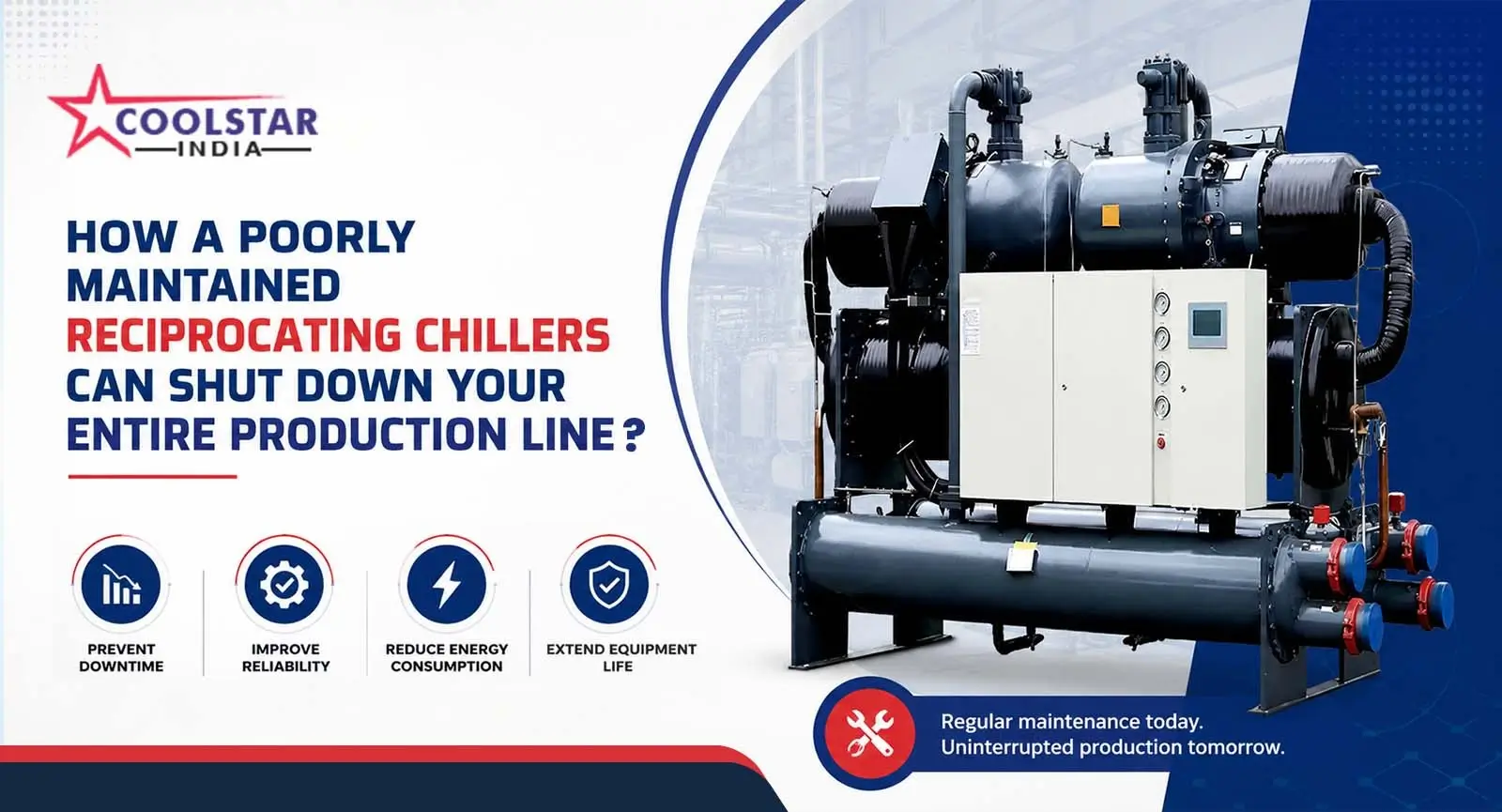
Most production managers do not think about the chiller until something goes wrong. It sits in the utility room, it hums along, and nobody pays attention to it. Until one morning the cooling drops, the process temperature climbs, and the production line has to stop.
That is the moment people realize how much of the operation depends on a single piece of equipment. A reciprocating chiller that is not maintained properly does not just underperform quietly. It fails in ways that bring everything connected to it to a halt.
This post covers what goes wrong when maintenance is neglected, what the warning signs look like, and what a proper maintenance routine actually involves.
What a Reciprocating Chiller Does in a Production Environment?
Before getting into what goes wrong, it helps to understand what these units are doing.
The compressor is piston-driven. It compresses refrigerant, which absorbs heat from the process fluid. That heat travels through the cycle and gets pushed out through the condenser. Cooled fluid returns to the process. The compressor keeps running, the heat keeps leaving, and the process temperature stays where it should be.
What makes reciprocating chillers particularly suited to industrial and commercial applications is their flexible capacity control and their ability to handle fluctuating loads without losing performance. They work across industrial cooling processes, food and beverage production, pharmaceutical manufacturing, chemical processing, plastic manufacturing, data centres, hospitals, cold storage, and HVAC systems in commercial buildings.
In short, they are carrying a significant part of the thermal load in most facilities that run them. When they stop working, the process stops with them.
What Happens When Maintenance Gets Neglected?
Refrigerant leaks
Reciprocating chillers that are losing refrigerant does not cool as efficiently as it should. The system has to work harder to move the same amount of heat, which puts more strain on the compressor. Cooling capacity drops. Process temperatures start creeping up. If the leak goes undetected long enough, the system eventually cannot keep up with the process demand at all.
Refrigerant leaks are one of the most common issues in poorly maintained systems, and one of the most preventable. Regular checks of refrigerant levels and leak testing catch this early, before it becomes a capacity problem.
Dirty condenser coils
The condenser is where the chiller rejects heat to the outside. When the coils get coated in dust, debris, or scale, heat cannot transfer efficiently. The chiller runs hotter, the compressor works harder, and energy consumption goes up. Eventually, the system trips on high pressure or overheats.
In a facility running continuous production shifts, a tripped chiller at the wrong moment means a line stoppage. Cleaning the condenser coils is one of the most straightforward maintenance tasks, and one of the most commonly skipped.
Fouled evaporator
The evaporator is where the chiller absorbs heat from the process fluid. When the heat transfer surfaces on the evaporator get fouled with scale or deposits, the chilled fluid coming out of the unit is not as cold as it should be. The process runs warm. Quality suffers. In food and pharmaceutical applications, that temperature deviation is not just a production issue. It is a compliance issue.
Worn compressor components
The reciprocating compressor has moving parts. Pistons, valves, bearings. Over time, with use and without proper lubrication and servicing, those parts wear. Worn valve plates reduce compression efficiency. Bearing wear shows up as vibration and noise. Left unaddressed, worn compressor components lead to compressor failure. A failed compressor is not a quick fix. It is a major repair or replacement job, with corresponding downtime.
Electrical and control system faults
Contactors, relays, sensors, and control boards all need periodic checking. A faulty temperature sensor gives the control system wrong information, leading to incorrect operation. A worn contactor fails on start-up. A control board fault can prevent the chiller from starting at all, or cause erratic operation that is difficult to diagnose quickly.
The Warning Signs Most People Ignore
The chiller usually gives warnings before it fails completely. The problem is that in a busy production environment, those warnings get dismissed or put off until a quieter moment that never quite arrives.
Unusual noise or vibration from the compressor is one of the clearest early warning signs. Healthy reciprocating chillers run with low noise and vibration levels. When that changes, something is wearing or loose.
Higher than normal energy consumption without any change in the production load is another signal. If the chiller is drawing more power to deliver the same cooling, something is reducing its efficiency.
Chilled water temperature that takes longer to reach setpoint, or never quite gets there, points to reduced capacity. That could be refrigerant loss, fouling, or a compressor issue.
Repeated trips on pressure or temperature limits are not a coincidence. Something is pushing the system outside its normal range. Resetting the fault and moving on is not a fix. Finding what caused it is.
A Basic Maintenance Routine That Prevents Most Problems
Most chiller failures are preventable with consistent, basic maintenance. It does not require specialized knowledge for every task, just regular attention and prompt action when something looks off.
Weekly checks
Check the operating pressures and temperatures against the normal baseline. Listen for noise or vibration that should not be there. Look at the refrigerant sight glass for bubbles. Write the readings down. Patterns only show up when there is something to compare against.
Monthly checks
Clean the condenser coils if they need it. Check electrical connections for signs of heat or corrosion and deal with anything that looks wrong. Test the safety controls and alarms to confirm they actually work. Check the water treatment in the chilled water circuit. These are not optional tasks.
Quarterly checks
Check refrigerant charge and test for leaks. Inspect compressor oil level and condition. Look for fouling on evaporator surfaces. Verify sensors, controls, and setpoints. Inspect valves and strainers. Do not assume anything is fine.
Annual service
A full annual service by a qualified technician covers compressor inspection, refrigerant system integrity, electrical testing, heat exchanger cleaning, and calibration of controls. This is the service that catches what routine checks might miss.
Reciprocating Chillers Manufacturers
Working with reputable reciprocating chiller manufacturers means getting equipment that is built to be maintained, not just built to run. Coolstar India designs reciprocating chillers with high efficiency, robust construction, low noise and vibration levels, flexible capacity control, and high part-load performance. These are features that make both operation and maintenance more manageable over the long service life of the equipment.
The units are suitable for a wide range of refrigerants and designed with easy maintenance as part of the specification, not an afterthought.
Conclusion
Reciprocating chillers that are looked after properly will run reliably for years. One that is ignored will fail, and it will not fail at a convenient time.
The maintenance tasks are not complicated. The cost of doing them is small compared to the cost of an unplanned shutdown. Most people only appreciate that after they are standing next to a stopped production line trying to figure out what went wrong.
Coolstar India supplies reciprocating chillers to industrial, food processing, pharmaceutical, and commercial facilities across India. Get in touch with the team to discuss your cooling requirements or to find out more about the range.
Frequently Asked Questions
The most reliable indicators are changes from normal operating behaviour. Higher energy consumption, chilled water that takes longer to reach setpoint, unusual noise or vibration from the compressor, or frequent tripping on safety limits. Any of these warrants investigation rather than waiting for the next scheduled service.
At least quarterly, and any time there is a change in cooling performance. Refrigerant loss is gradual and often goes unnoticed until capacity is significantly reduced. Catching a slow leak early is considerably less disruptive and less expensive than dealing with the consequences of running low for an extended period.
Yes. A severely fouled condenser reduces heat rejection capacity, which causes the system to run at elevated pressures and temperatures. Most chiller control systems will trip the unit on a high pressure or high temperature safety limit before damage occurs. The result is a chiller that will not restart until the fault is addressed, which means no cooling until that happens.
Reciprocating chillers that are properly maintained and operated within its design parameters can run reliably for many years. The compressor is the component with the most wear, and regular oil checks, pressure testing, and annual inspections significantly extend its service life.
For critical production environments, yes. Keeping key consumables and wear parts on hand, such as refrigerant, oil, filter dryers, and common electrical components, reduces the downtime when a routine replacement is needed. It also avoids the situation where a minor repair turns into a prolonged shutdown because a part has to be sourced and delivered.

